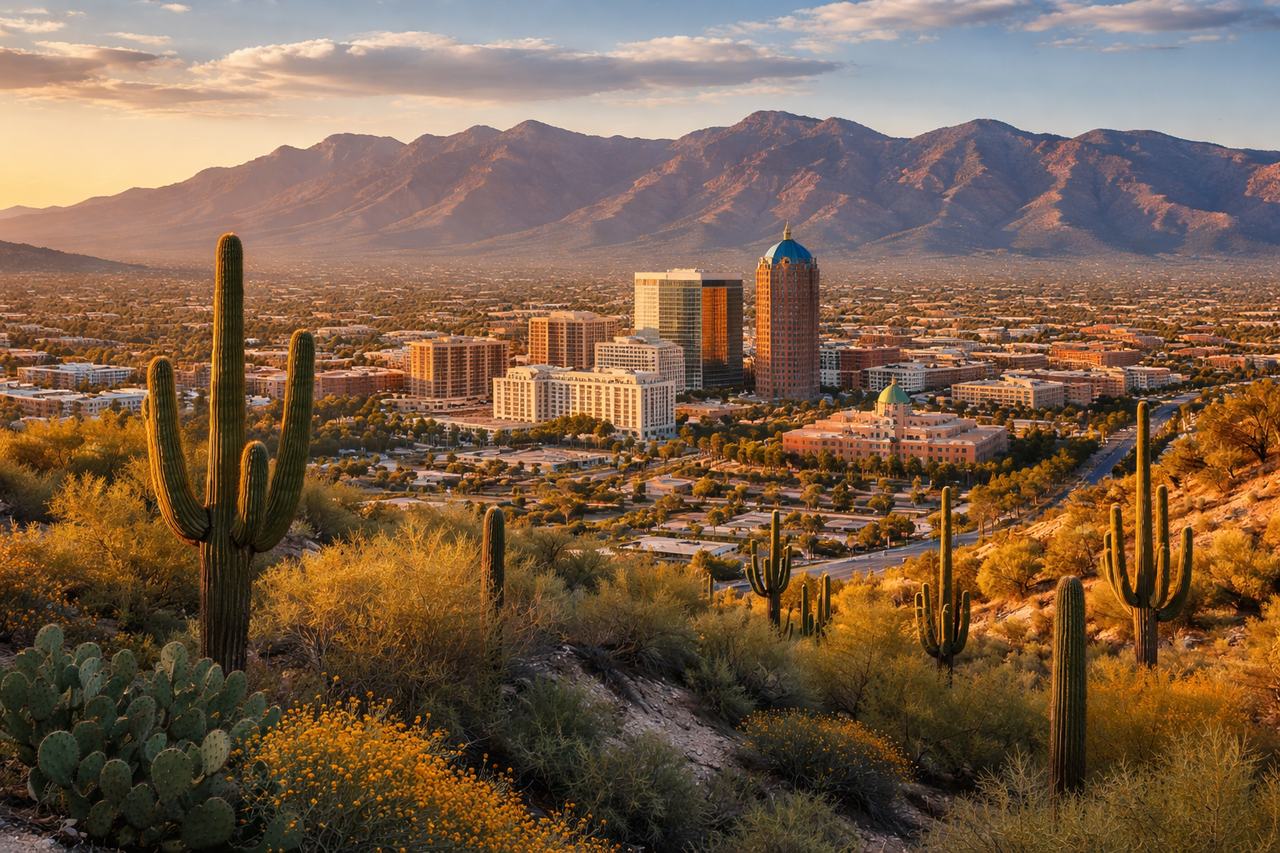
Tucson, Arizona is an increasingly attractive real estate investment market driven by population growth, relative affordability compared to Phoenix, and strong rental demand. Investors are drawn to Tucson for its balance of cash flow potential and long-term appreciation.
DSCR loans allow investors to qualify based on rental income instead of personal income, making them an effective financing solution for acquiring and scaling rental properties in Tucson.
- Strong rental demand driven by population growth and migration
- More affordable entry point compared to Phoenix metro
- Growing economy with university and military presence
- No need for tax returns or employment verification
What Is a DSCR Loan?
A DSCR (Debt Service Coverage Ratio) loan focuses on whether a property generates enough rental income to cover its mortgage. This allows investors to qualify without relying on personal income documentation.
Learn more here: How DSCR Loans Work
Run your numbers with our DSCR Calculator.
Why Tucson Is a Growing Investment Market
Tucson benefits from continued migration into Arizona, as well as economic drivers like the University of Arizona, defense sector employment, and healthcare growth.
- Population growth supporting long-term housing demand
- University-driven rental demand
- Lower price points than Phoenix
- Potential for both income and appreciation
Investment Strategies That Work in Tucson
Tucson supports a mix of growth and income-focused strategies:
- Long-term rentals: Stable and consistent income (Learn more)
- Student housing: Strong demand near the University of Arizona
- Short-term rentals: Opportunity in select areas with tourism demand (Short-term rental financing)
- Buy and hold: Capture long-term appreciation
DSCR Loan Requirements in Tucson
Typical DSCR loan guidelines include:
- Minimum DSCR: Usually 1.0–1.25+
- Down payment: 20–25%
- Credit score: 620+
- Reserves: Typically 3–6 months
See more details: Credit Requirements and Down Payment Guidelines
Best Areas in Tucson for Investment
Tucson offers a range of submarkets depending on your investment goals:
- Near University of Arizona: Student rental demand
- Central Tucson: Established rental neighborhoods
- North and Northwest Tucson: Higher-end long-term rentals
- Emerging areas: Opportunities for appreciation and value-add
Local zoning and short-term rental regulations should be reviewed when selecting a property.
Scaling a Rental Portfolio in Tucson
Tucson allows investors to combine income generation with long-term growth. DSCR loans enable you to scale based on rental income performance instead of personal income limits.
Learn more: Scaling Real Estate Investments
Analyze Your Investment Before You Buy
Before purchasing a Tucson investment property, evaluate rent potential, property location, and long-term growth trends.
Use our tools at Blue Castle Management to analyze your investment decisions.
Explore More DSCR Loan Markets
Get Pre-Approved for a DSCR Loan in Tucson
If you’re investing in Tucson real estate, a DSCR loan can help you secure rental properties, generate income, and build long-term wealth.
Start Your DSCR Loan Pre-Approval
Connect with our team to structure the right DSCR loan for your investment strategy.
Get StartedLocal investor field notes
Tucson, AZ DSCR field notes for rental investors
A DSCR review in Tucson, AZ should connect the loan calculation to the way renters actually use the local market. Investors often start with purchase price and expected rent, but the stronger file usually explains why the rent is supportable, what expenses could move after closing, and how the property would perform if the first lease, first guest season, or first renewal is less optimistic than expected.
For Tucson, AZ rental properties, local context can include University of Arizona, Banner University Medical Center, Davis-Monthan, downtown Tucson, Oro Valley, and Catalina Foothills. Those anchors do not guarantee cash flow, but they help an investor think through commute patterns, renter depth, neighborhood boundaries, parking expectations, maintenance access, and whether the property is competing with newer rentals, older workforce housing, student-oriented units, or vacation-oriented supply.
How to underwrite the rent before ordering the loan
Before relying on a DSCR number, compare current leases, market rent, and the appraiser’s rent support against the full proposed payment. The full payment should include principal, interest, taxes, insurance, HOA dues when applicable, and any property-level costs that affect the investor’s real cash flow. In Tucson, AZ, investors should be especially careful when the pro forma assumes premium rent, short vacancy, low repair costs, or a refinance value that depends on improvements not yet complete.
Demand to document
Look for evidence of student, medical, military, retiree, and workforce rental demand. Lease comps, listing history, property condition, and location-specific renter expectations can all affect whether the rent support is credible.
Property types to compare
Common scenarios include single-family rentals, small multifamily, and properties serving university or medical corridors. Each property type can produce a different DSCR result because taxes, insurance, HOA dues, repairs, and management costs are not identical.
Structure to test
Compare purchase, rate-and-term refinance, and cash-out scenarios before choosing leverage. A lower loan amount can sometimes make the deal stronger if it protects DSCR and reserves.
Questions for Tucson, AZ DSCR borrowers
- Does the supported rent cover the proposed payment after taxes, insurance, HOA dues, and realistic vacancy assumptions?
- Is the property best evaluated as a long-term rental, short-term rental, small multifamily, or refinance of an already stabilized asset?
- Will title be held personally or through an LLC, and are the entity documents, insurance, and signing authority ready before closing?
- Could a reserve cushion absorb a slower lease-up, repairs after inspection, local insurance changes, or a lower-than-expected rent schedule?
The practical goal is not simply to pass a ratio on paper. It is to choose a DSCR loan structure that still makes sense after the real property expenses show up. That is why 360 Mortgage reviews the rent support, loan-to-value, reserves, property use, credit profile, and closing plan together before recommending the next step.
Extra diligence for thinner files
If the page’s first-pass numbers are close, investors should slow down and test a downside version of the deal. Lower the rent estimate, raise the insurance assumption, add a repair reserve, and compare the result with the DSCR threshold. In Tucson, AZ, that extra pass can separate a rental that only works in a spreadsheet from one that can survive normal turnover, repairs, and market noise.
Investors should also compare the exit plan before choosing a loan amount. A buy-and-hold rental may need stable lease demand more than top-line appreciation. A refinance strategy may need documented improvements, a realistic value opinion, and enough time for the new rent to be supported. A short-term or mid-term rental plan may need proof that local rules, HOA rules, furnishing costs, and management costs still leave enough income after debt service.
For borrowers building a portfolio, the best DSCR conversation usually includes both the subject property and the next property. Reserves, liquidity, entity structure, insurance renewal timing, and existing mortgage payments can all affect how quickly an investor can scale. Reviewing those details early helps prevent a technically approvable loan from becoming a weak long-term portfolio decision.

DSCR and Investor Loan Guidance
Talk Through DSCR Loan Options With Lyndi Gajan
Real estate investors can work with Lyndi Gajan to talk through DSCR loan questions, rental income scenarios, refinance options, and investor documentation before choosing a loan path.
Lyndi Gajan NMLS ID 88249. 360 Mortgage Inc. NMLS ID 80777. Loan availability, licensing, and guidelines vary by state, property, and loan purpose.