
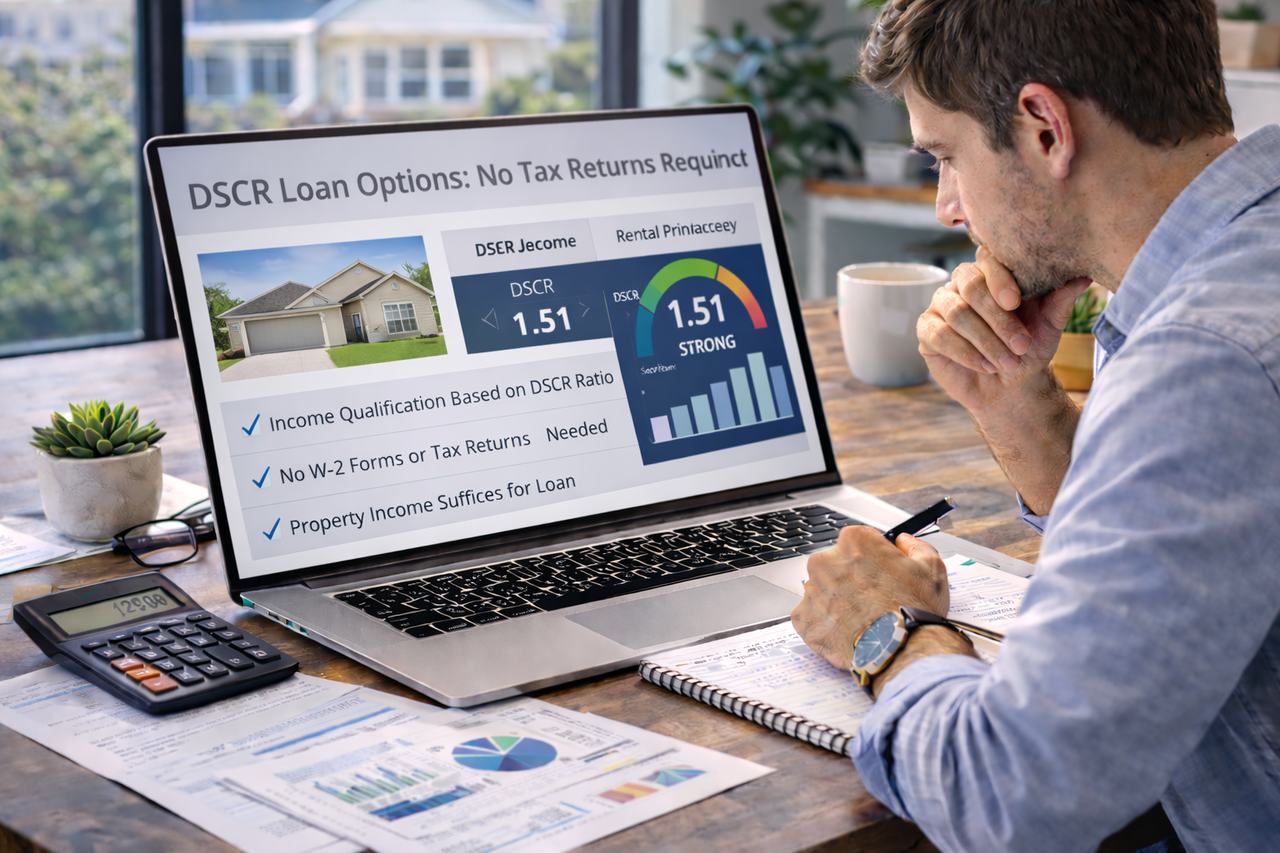
DSCR Loans With No Tax Returns for Real Estate Investors
Many real estate investors look for investment property loans with no tax returns required because traditional underwriting often becomes more difficult as rental portfolios grow. Once depreciation, business deductions, and multiple properties enter the picture, tax returns may not fully reflect an investor’s real financial strength.
That is one reason DSCR loans have become so popular. These loans are typically underwritten primarily based on the income produced by the property rather than the borrower’s personal tax return income.
If you are new to this financing model, start with our guides on what DSCR means and how DSCR loans work.
Many investors are not looking to avoid documentation altogether. They are looking to avoid a financing model that penalizes them for legitimate write offs, depreciation, and business structuring that reduce taxable income on paper.
Can You Get a DSCR Loan Without Tax Returns?
In many cases, yes. One of the main appeals of a DSCR loan is that the lender typically focuses on whether the rental property generates enough income to support the monthly debt payment rather than requiring personal tax returns to prove borrower income.
That makes DSCR financing especially appealing for:
- Self employed investors
- Borrowers with complex tax returns
- Investors with multiple rental properties
- Business owners whose write offs reduce taxable income
- Borrowers who want a more scalable financing structure
Related pages:
- No income verification DSCR loans
- DSCR loans for self employed investors
- DSCR loans for LLC borrowers
How DSCR Loans Work Without Tax Returns
Instead of relying primarily on borrower tax return income, DSCR loans look at whether the property’s rental income is sufficient to cover the monthly debt obligation.
If the property’s income supports the debt payment, the deal may qualify even if the borrower is not using tax returns to document personal income.
Supporting resources:
DSCR loans work best when the property itself is strong enough to carry the financing. Investors who rely on no tax return qualification should pay even more attention to rent quality, reserves, and realistic property level underwriting.
Why Tax Returns Can Be a Problem for Real Estate Investors
Traditional mortgage underwriting often assumes that tax returns provide a clear picture of borrower strength. For real estate investors, that is not always true.
Investors frequently use legitimate tax strategies that reduce taxable income, including:
- Depreciation
- Business expense deductions
- Property related write offs
- Entity based ownership structures
- Income offset by prior losses or operating costs
As a result, an investor may have strong cash reserves, significant equity, and multiple performing properties while still appearing weaker than expected in a conventional tax return based underwriting model.
What Documents Are Used Instead of Tax Returns?
Even if tax returns are not the centerpiece of the file, there is still underwriting. The lender usually evaluates other aspects of the transaction to determine whether the property and borrower fit the program.
Common items may include:
- Credit report and credit score
- Asset and reserve documentation
- Lease agreements
- Market rent analysis
- Appraisal and rent schedule support
- Entity documents when borrowing through an LLC
So the phrase no tax returns does not mean no documentation. It means the loan is generally not being approved or denied mainly on the basis of borrower tax return income.
A DSCR loan with no tax returns required is still a real underwritten mortgage. Investors should expect the lender to review credit, reserves, property income, and overall eligibility even if personal tax returns are not central to the file.
How Rental Income Is Verified Instead
Because personal tax returns are not the main qualification tool, the lender relies more heavily on the property’s income profile. Depending on the transaction, that may involve current leases, market rent estimates, or appraiser supported rent schedules.
This is why investors should understand:
- Whether current rent is at market level
- Whether the property is occupied or vacant
- Whether comparable rents support the projected income
- Whether the property still cash flows after realistic expenses
Related resources:
Who Benefits Most From DSCR Loans With No Tax Returns?
These loans are often a strong fit for investors whose real financial strength is better reflected by their assets and property performance than by their taxable income.
That often includes:
- Experienced rental property investors
- Self employed borrowers
- Business owners
- Investors planning to scale a portfolio
- Borrowers with multiple income sources and complex returns
These pages may also be helpful:
- DSCR loans for first time investors
- Scaling a rental portfolio
- How many properties can you buy
- DSCR cash out refinance
Many investors choose DSCR loans with no tax returns required not just to make one transaction easier, but to create a financing model they can keep using as their portfolio becomes larger and more complex.
Property Types Commonly Financed This Way
DSCR loans with no tax return based qualification are commonly used across several investment property categories, depending on the lender and program.
- Single family rentals
- Small multifamily properties
- Condo rental investments
- Airbnb properties
- Vacation rentals
Property type matters because rent stability, expenses, and lender appetite can vary significantly by asset class.
Typical Requirements Still Matter
Even when tax returns are not required, other underwriting standards still apply. Borrowers should still expect the lender to evaluate major risk factors such as:
- Credit score
- Down payment or equity position
- Reserve requirements
- Property eligibility
- Minimum DSCR level
- Loan to value ratio
For more detail, review:
- DSCR loan requirements
- Credit score requirements
- Down payment requirements
- LTV limits
- Reserve requirements
- DSCR loans for lower credit score investors
- DSCR loans are one of the most common ways investors finance rental properties without relying on tax returns
- The property’s income usually matters more than borrower tax return income
- There is still underwriting, but it is centered more on the asset and borrower strength outside of tax returns
- Strong rent, reserves, and realistic property analysis still matter
No Tax Returns vs No Income Verification
These phrases are closely related, but they are not always identical. Some investors specifically want a loan that does not require tax returns. Others want a broader no income verification structure that avoids traditional personal income underwriting entirely.
DSCR loans often appeal to both groups because they shift the underwriting focus to property income.
For the related topic, see:
DSCR Loans With No Tax Returns vs Conventional Investor Loans
The contrast with conventional investor financing is usually significant. Conventional investor loans often depend much more heavily on borrower tax returns, W 2 income, and debt to income calculations. DSCR loans generally depend more on rent and debt service coverage.
Comparison pages:
Owning rental property involves more than securing financing. Investors must also manage leasing, tenant screening, maintenance, and vacancy risk. For practical landlord guides and rental property management insights, visit Blue Castle Management.
Cash Flow Still Matters Even Without Tax Returns
A loan that does not require tax returns can still fund a bad investment if the investor does not analyze the property carefully. Approval is not the same as performance.
Before moving forward, investors should still model:
- True monthly cash flow
- Vacancy assumptions
- Repairs and maintenance
- Insurance and tax exposure
- Break even performance
Helpful resources:
- Rental property cash flow
- How to calculate rental cash flow
- Rental property expenses list
- Rental property break even analysis
- Risk analysis for rental properties
The strongest investors use no tax return DSCR financing as a tool, not a shortcut. They pair flexible financing with disciplined underwriting so the portfolio grows on solid ground rather than on weak assumptions.
Talk With a DSCR Loan Specialist About Investment Property Financing Without Tax Returns
If you want to finance a rental property without relying on personal tax returns, a DSCR loan may be a strong fit.
We help real estate investors evaluate financing options based on rental income, property performance, and long term portfolio goals.
Talk With an Investor Loan Specialist
DSCR and Investor Loan Guidance
Talk Through DSCR Loan Options With Lyndi Gajan
Real estate investors can work with Lyndi Gajan to talk through DSCR loan questions, rental income scenarios, refinance options, and investor documentation before choosing a loan path.
Lyndi Gajan NMLS ID 88249. 360 Mortgage Inc. NMLS ID 80777. Loan availability, licensing, and guidelines vary by state, property, and loan purpose.
Frequently asked questions
Who is DSCR Loans With No Tax Returns for Real Estate Investors best for?
DSCR Loans With No Tax Returns for Real Estate Investors may fit borrowers whose goals, documentation and property details line up with the program requirements. A mortgage review is the fastest way to compare options without relying on generic assumptions.
What documents should I prepare?
Most borrowers should be ready to discuss income, assets, debts, credit history, property details and the purpose of the loan. Exact documentation depends on the program and underwriting review.
What is the next step?
The next step is to talk with 360 Mortgage so the team can review your situation, explain available options and outline the application path.