
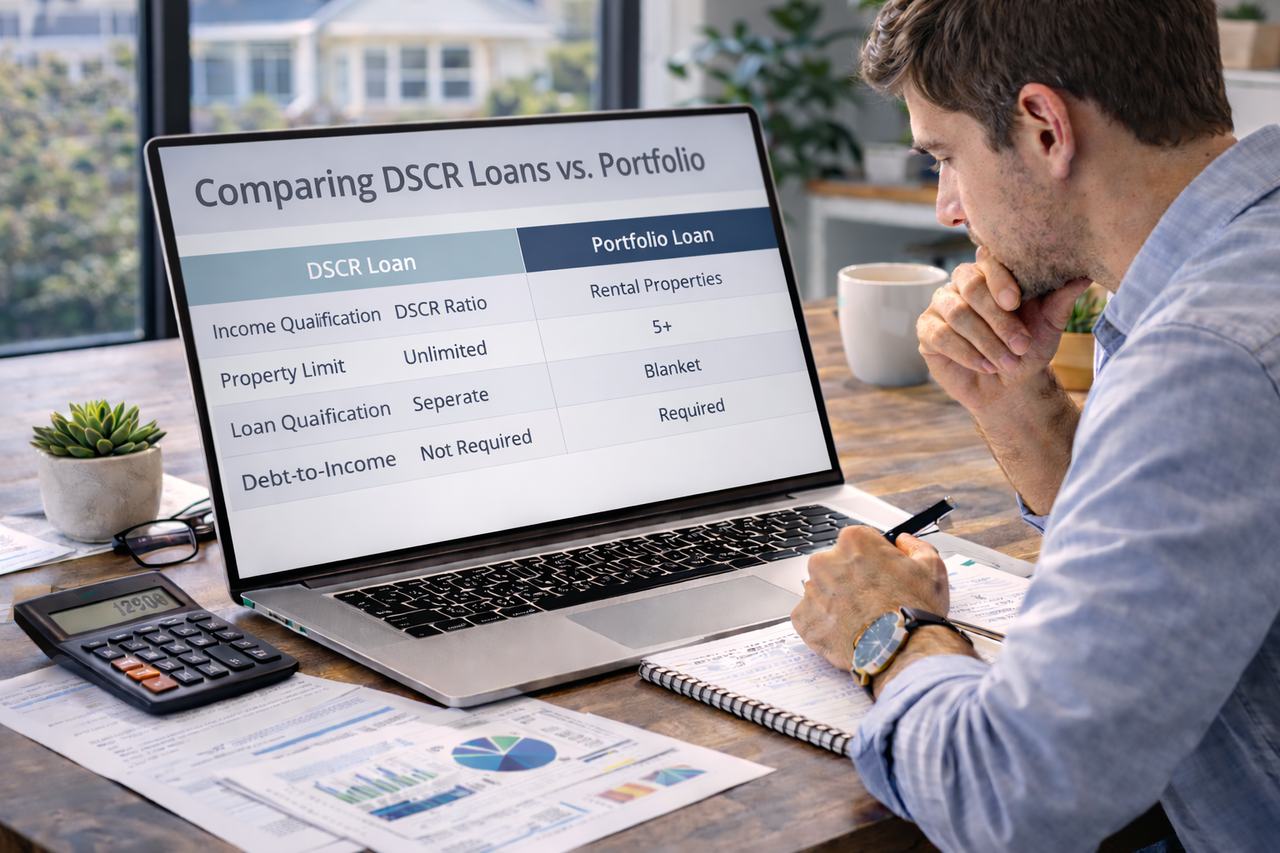
DSCR Loans vs Portfolio Loans for Real Estate Investors
Real estate investors often compare DSCR loans and portfolio loans because both can provide alternatives to conventional mortgage financing. While the two loan types can overlap in some situations, they are not the same thing.
A DSCR loan is primarily underwritten based on the rental income generated by the property. A portfolio loan is a broader category that usually refers to a loan a lender keeps in its own portfolio instead of selling on the secondary market. Because of that, portfolio lenders often have more flexibility in how they structure underwriting.
For some investors, DSCR loans are the cleaner and more scalable option. For others, a portfolio loan may solve a more unusual financing problem.
| Decision factor | DSCR loan may fit better | Portfolio loan may fit better |
|---|---|---|
| Primary need | A repeatable rental-property financing approach centered on property cash flow | A customized structure for a scenario outside more standardized programs |
| Property or deal | A standard eligible investment property with supportable rent | An unusual property, borrower profile, or multi-property structure requiring lender discretion |
| What to compare | Rent calculation, reserves, leverage, costs and prepayment terms | Global financial review, collateral structure, term, balloon risk, costs and lender-specific conditions |
Direct answer: Choose based on the actual underwriting method and loan terms—not the product label alone. Some portfolio lenders may offer DSCR-style underwriting, so the categories can overlap.
If you are new to DSCR financing, start with our guides on what DSCR means and how DSCR loans work.
Many investors assume portfolio loans are automatically more flexible than DSCR loans. Sometimes they are. But flexibility often comes with tradeoffs in rate, structure, prepayment terms, or lender specific constraints.
What Is a DSCR Loan?
A DSCR loan is an investment property loan that focuses primarily on whether the property’s income can support the monthly debt payment.
If the ratio is strong enough, the property may qualify even if the borrower prefers not to rely on tax returns or traditional debt to income underwriting.
Supporting resources:
What Is a Portfolio Loan?
A portfolio loan usually refers to a loan a lender keeps on its own books rather than packaging and selling into the secondary market. Because the lender retains the loan, it may have more freedom to set guidelines that differ from standardized agency style lending.
That flexibility may allow portfolio lenders to finance scenarios such as:
- Unique properties
- Borrowers with complicated financials
- Properties that do not fit standardized guidelines
- Blanket style or cross collateralized structures in some cases
- Situations where a lender is comfortable making an exception
The exact meaning of portfolio loan can vary by lender, which is one reason investors should always look closely at the actual loan structure rather than relying on the label alone.
A DSCR loan is often best when you want a repeatable, property based financing model. A portfolio loan is often more useful when the deal is unusual, the property is harder to fit into standard boxes, or the financing structure itself needs customization.
Main Difference Between DSCR Loans and Portfolio Loans
The biggest difference is that DSCR is an underwriting approach, while portfolio is more about where the loan lives after closing and how the lender chooses to structure it.
- DSCR loan: usually property income focused underwriting
- Portfolio loan: usually lender retained loan with potentially more customized terms
A portfolio lender may even offer a DSCR style loan. In other words, these categories are not always opposites. Sometimes they overlap.
When DSCR Loans May Be the Better Fit
DSCR loans often make sense for investors who want a relatively streamlined, repeatable financing structure for standard rental properties.
They may be especially attractive for:
- Single family rentals
- Small multifamily properties
- Condo rentals
- Short term rentals in eligible programs
- Investors planning to scale over time
Related property type pages:
DSCR loans are also popular with investors who want:
- Qualification based more on property income than personal tax returns
- A scalable financing model
- LLC borrowing options in eligible programs
- Cash out refinance opportunities tied to rental performance
Related pages:
When Portfolio Loans May Be the Better Fit
Portfolio loans may be more attractive when the deal has characteristics that fall outside the comfort zone of standardized DSCR programs.
Examples may include:
- Properties with unusual characteristics
- Borrowers needing more customized structures
- Mixed use or edge case assets
- Situations involving multiple properties or blanket financing
- Borrowers who need lender discretion beyond standardized DSCR overlays
In these scenarios, a portfolio lender may be able to work through complexity that a more standardized DSCR product cannot.
Greater flexibility does not automatically mean better financing. Customized loans can sometimes carry higher rates, shorter terms, balloons, prepayment penalties, or lender specific conditions that reduce long term flexibility.
Documentation and Underwriting Differences
DSCR loans often emphasize the property’s projected or documented rental income, while portfolio lenders may underwrite using a wider mix of borrower level and property level considerations.
DSCR Loans Often Focus On
- Rental income
- Debt service coverage ratio
- Credit score
- Down payment or equity
- Reserve requirements
Portfolio Loans May Also Consider
- Relationship with the lender
- Total global cash flow
- Broader borrower financial strength
- Property uniqueness
- Cross collateral strength or other structural considerations
For more on DSCR qualification, review:
- DSCR loan requirements
- Credit score requirements
- Down payment requirements
- Reserve requirements
- LTV limits
Which Option Is Easier to Scale With?
For many investors, DSCR loans are easier to scale with because they are designed to be repeated across standard rental property acquisitions. That repeatability matters when the goal is to grow a portfolio over time.
Portfolio loans can still play an important role, especially when a deal does not fit cleanly into standardized DSCR guidelines. But for pure repeatable acquisition volume, DSCR often has the advantage.
Related pages:
- How many properties can you buy
- DSCR loans for first time investors
- DSCR vs conventional investor loans
Many experienced investors use DSCR loans for standard properties and reserve portfolio loans for exceptions. That can create the best of both worlds: scalable financing where possible and customized solutions where necessary.
Rate and Structure Tradeoffs
The best financing option is not always the one with the most flexible underwriting. Investors should compare the full structure of the loan, not just whether the deal gets approved.
Important tradeoffs may include:
- Interest rate
- Origination cost
- Loan term
- Balloon features
- Prepayment penalty
- Refinance flexibility later
Related pages:
As rental portfolios grow, strong operational systems become essential. Investors looking for guidance on tenant screening, leasing strategies, property management, and landlord best practices can explore the educational resources available at Blue Castle Management.
Cash Flow Still Matters No Matter Which Loan You Choose
Whether you use a DSCR loan or a portfolio loan, the property still has to perform. Financing can help a deal work, but it cannot rescue a weak investment forever.
Before choosing a loan structure, investors should model:
- True monthly cash flow
- Vacancy assumptions
- Maintenance and capital expenditures
- Insurance and tax risk
- Break even levels
These resources can help:
- Rental property cash flow
- How to calculate rental cash flow
- Rental property expenses list
- Rental property break even analysis
- Risk analysis for rental properties
- DSCR loans and portfolio loans are not exact opposites
- DSCR is an underwriting model centered on property income
- Portfolio loans are lender retained loans that may allow more customization
- DSCR loans are often better for repeatable portfolio growth
- Portfolio loans may be better for unusual properties or financing structures
Should You Use a DSCR Loan or a Portfolio Loan?
If you are financing a standard rental property and want a repeatable, property income based structure, a DSCR loan is often the stronger fit. If the property or borrower scenario is more complex and requires lender discretion, a portfolio loan may be more useful.
The right choice depends on the property, the borrower, the financing structure, and the long term plan. For many investors, the smartest approach is not choosing one forever. It is understanding when each tool fits best.
Talk With a DSCR Loan Specialist About the Right Investor Financing Strategy
If you are comparing DSCR loans and portfolio loans, we can help you evaluate which structure fits your property, cash flow goals, and long term portfolio strategy.
We help real estate investors explore available rental-property purchase and refinance options. Program availability, licensing, property eligibility, and guidelines vary by state and loan purpose.
Talk With an Investor Loan Specialist
DSCR and Investor Loan Guidance
Talk Through DSCR Loan Options With Lyndi Gajan
Real estate investors can work with Lyndi Gajan to talk through DSCR loan questions, rental income scenarios, refinance options, and investor documentation before choosing a loan path.
Lyndi Gajan NMLS ID 88249. 360 Mortgage Inc. NMLS ID 80777. Loan availability, licensing, and guidelines vary by state, property, and loan purpose.
DSCR vs. portfolio loan FAQs
What is the main difference between a DSCR loan and a portfolio loan?
DSCR describes an underwriting approach centered on property income relative to debt service. A portfolio loan generally describes a loan the lender keeps rather than sells, which may allow lender-specific underwriting and structure. A portfolio loan can sometimes use DSCR-style underwriting.
When might a DSCR loan fit an investor better?
A DSCR loan may fit when an eligible rental property has supportable cash flow and the investor wants a repeatable property-focused financing approach. The actual fit depends on the property, borrower, loan purpose and available program.
When might a portfolio loan fit better?
A portfolio loan may be worth exploring when the property, borrower profile or proposed structure does not fit more standardized investor-loan programs. Terms and documentation vary by lender, so investors should compare the complete offer.
What terms should investors compare before choosing?
Compare the underwriting method, rent calculation, required documentation, cash or equity needed, reserves, loan term, balloon features, costs, prepayment provisions, refinance flexibility and any collateral or relationship requirements.