Direct answer
What should borrowers know about using a cash out refinance to pay off debt?
Using a Cash Out Refinance to Pay Off Debt is mainly about matching the borrower, property, loan purpose and timing to the right mortgage refinance path. Eligibility and pricing can depend on credit profile, income documentation, debt-to-income ratio, property type, occupancy, loan amount, equity or down payment, and current program rules.
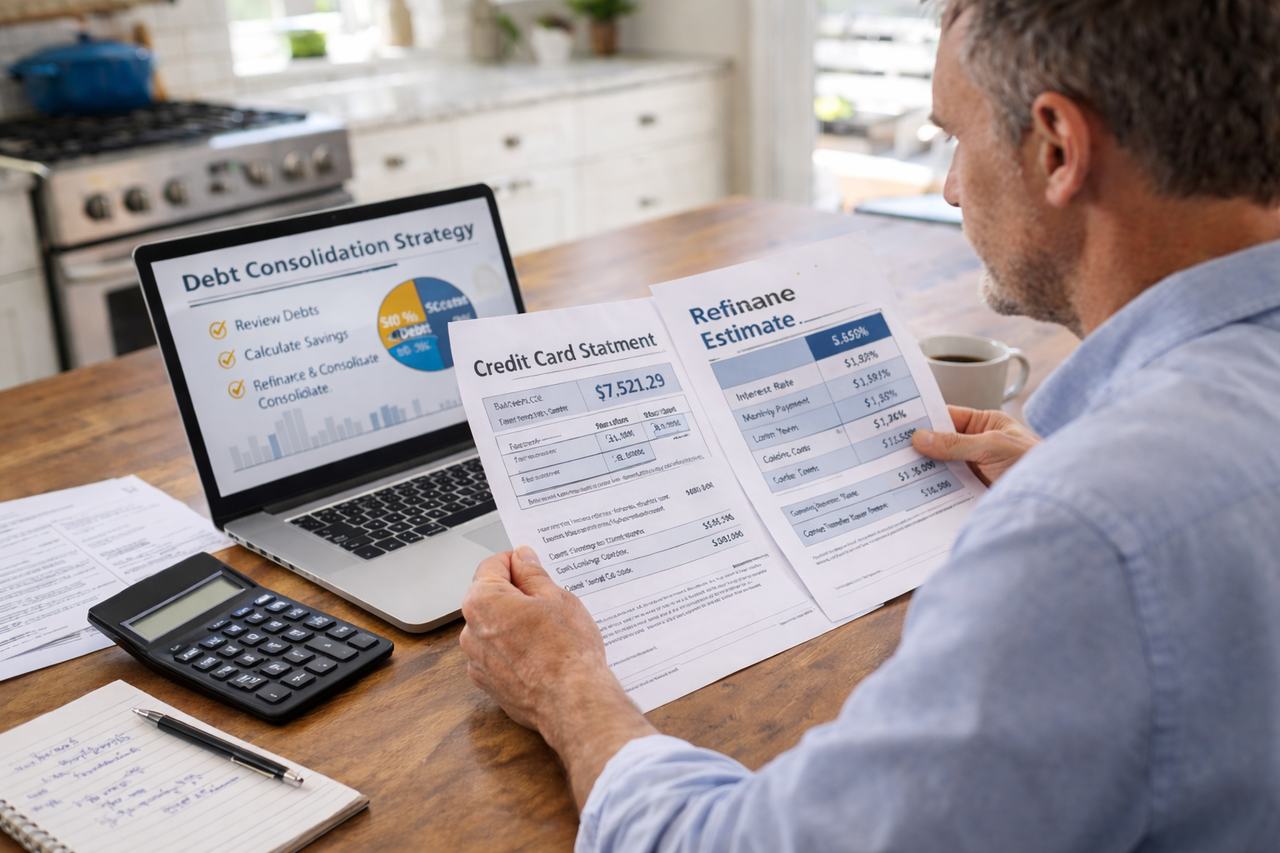
Using a Cash Out Refinance to Pay Off Debt
Many homeowners consider using a cash out refinance to pay off high interest debt. By refinancing the mortgage and withdrawing equity from the home, borrowers can use the funds to eliminate credit cards, personal loans, or other obligations that carry much higher interest rates.
In some situations this strategy can reduce monthly payments and simplify finances. However, it also changes the structure of the debt in important ways. Before using home equity to consolidate debt, homeowners should understand both the benefits and the risks.
This guide explains how debt consolidation through a cash out refinance works and the factors that determine whether it is a responsible financial move.
For the full refinance hub, visit our Mortgage Refinance Guide.
How Cash Out Refinance Debt Consolidation Works
A cash out refinance replaces your existing mortgage with a new loan that is larger than the current balance. The difference between the new loan amount and the old balance is distributed to you as cash at closing.
Those funds can then be used to pay off other debts.
Example:
- Current mortgage balance: $240,000
- Home value: $400,000
- New refinance loan: $290,000
- Cash available: about $50,000
The $50,000 could be used to pay off credit cards, personal loans, or other obligations.
The new mortgage then becomes your only remaining loan tied to the home.
Related page: Cash Out Refinance Overview
Why Homeowners Consider This Strategy
There are several reasons homeowners explore debt consolidation through refinancing.
Lower Interest Rates
Mortgage interest rates are often lower than credit card rates or unsecured personal loan rates. By consolidating debt into the mortgage, borrowers may reduce the interest rate on that portion of their debt.
Simplified Payments
Instead of managing multiple credit card or loan payments, homeowners may consolidate everything into a single monthly mortgage payment.
Lower Monthly Payment
Because mortgage repayment periods are long, the monthly payment required to repay the debt may be lower than the combined payments on credit cards or personal loans.
However, lower payments do not automatically mean lower long term cost.
The Biggest Structural Change: Secured vs Unsecured Debt
One of the most important things to understand is how the nature of the debt changes.
Credit cards and personal loans are typically unsecured. If a borrower falls behind, the lender may pursue collections and credit damage, but the debt is not tied to a specific asset.
Mortgage debt is secured by the home.
When unsecured debt is converted into mortgage debt through a refinance, the home becomes collateral for that portion of the debt.
This means failure to repay could ultimately threaten the home itself.
Related page: Cash Out Refinance Risks
Potential Advantages of Using Home Equity to Pay Off Debt
When used carefully and strategically, a cash out refinance can offer several advantages.
- Lower interest rates compared with credit cards
- One consolidated monthly payment
- Potentially lower monthly obligations
- Improved short term cash flow
- Clear repayment structure
For homeowners facing high interest revolving debt, these benefits can create breathing room.
Potential Downsides to Consider
You May Pay Interest Much Longer
Mortgage terms often stretch across decades. While the interest rate may be lower, spreading repayment over many years can increase total interest paid.
In other words, the debt becomes cheaper each month but potentially more expensive overall.
You Increase the Mortgage Balance
Refinancing increases the total loan balance secured by the home. That reduces the amount of equity available and may increase financial risk if property values decline.
You May Restart the Mortgage Term
If you refinance into a new long term loan, the amortization schedule restarts. This may extend the time it takes to pay off the home.
Related page: Refinance Break Even Calculator
Behavioral Risk
One of the biggest risks with debt consolidation is behavioral rather than mathematical.
If credit cards are paid off using home equity but spending habits do not change, it is possible for debt to build up again while the mortgage balance remains higher.
This can create an even more difficult financial situation later.
Situations Where This Strategy May Make Sense
Using a cash out refinance for debt consolidation can sometimes be appropriate in certain situations.
- High interest debt is creating severe monthly payment pressure
- The borrower has strong equity in the home
- The refinance significantly lowers overall interest rates
- The borrower has a clear repayment plan going forward
- Spending behavior has changed or the underlying cause of the debt has been addressed
When these conditions are present, refinancing may improve financial stability.
Situations Where It May Be Risky
Homeowners should be cautious when:
- The equity cushion in the home is already small
- The refinance only slightly reduces interest rates
- The debt was created through ongoing spending rather than a one time event
- Income is unstable
- The homeowner may need to sell soon
In those cases, converting unsecured debt into mortgage debt could increase risk rather than reduce it.
Alternatives to Debt Consolidation Through Refinancing
Before using a cash out refinance, homeowners may want to compare other options.
Home Equity Loan
A home equity loan allows you to borrow against equity without replacing the primary mortgage.
Related page: Refinance vs Home Equity Loan
Home Equity Line of Credit
A HELOC provides flexible access to equity through a revolving credit line.
Related page: Refinance vs HELOC
Debt Repayment Plans
Some borrowers explore structured repayment strategies or financial counseling before converting unsecured debt into mortgage debt.
Questions to Ask Before Using Home Equity to Pay Off Debt
Before refinancing to consolidate debt, consider the following questions:
- Will the refinance truly improve my financial position?
- How much equity will remain in the home?
- Am I addressing the underlying cause of the debt?
- How much interest will I pay over the life of the new loan?
- Could another solution work without increasing mortgage risk?
These questions can help ensure the decision supports long term financial health.
Location Based Refinance Guidance
If you are considering a cash out refinance for debt consolidation, local market conditions may influence your options.
Explore refinance guidance in your area:
- Florida Mortgage Refinance
- Missouri Mortgage Refinance
- Kansas Mortgage Refinance
- Louisiana Mortgage Refinance
- Tennessee Mortgage Refinance
Talk With 360 Mortgage About Debt Consolidation Options
Debt consolidation through refinancing can help some homeowners regain financial stability, but it requires careful planning and realistic expectations.
A mortgage broker can help evaluate whether refinancing improves your financial position or whether another strategy may be more appropriate.
Contact 360 Mortgage to discuss your refinance options.
Return to the refinance hub here: Mortgage Refinance Guide
Frequently asked questions
Who is Using a Cash Out Refinance to Pay Off Debt best for?
Using a Cash Out Refinance to Pay Off Debt may fit borrowers whose goals, documentation and property details line up with the program requirements. A mortgage review is the fastest way to compare options without relying on generic assumptions.
What documents should I prepare?
Most borrowers should be ready to discuss income, assets, debts, credit history, property details and the purpose of the loan. Exact documentation depends on the program and underwriting review.
What is the next step?
The next step is to talk with 360 Mortgage so the team can review your situation, explain available options and outline the application path.